Identification of materiality
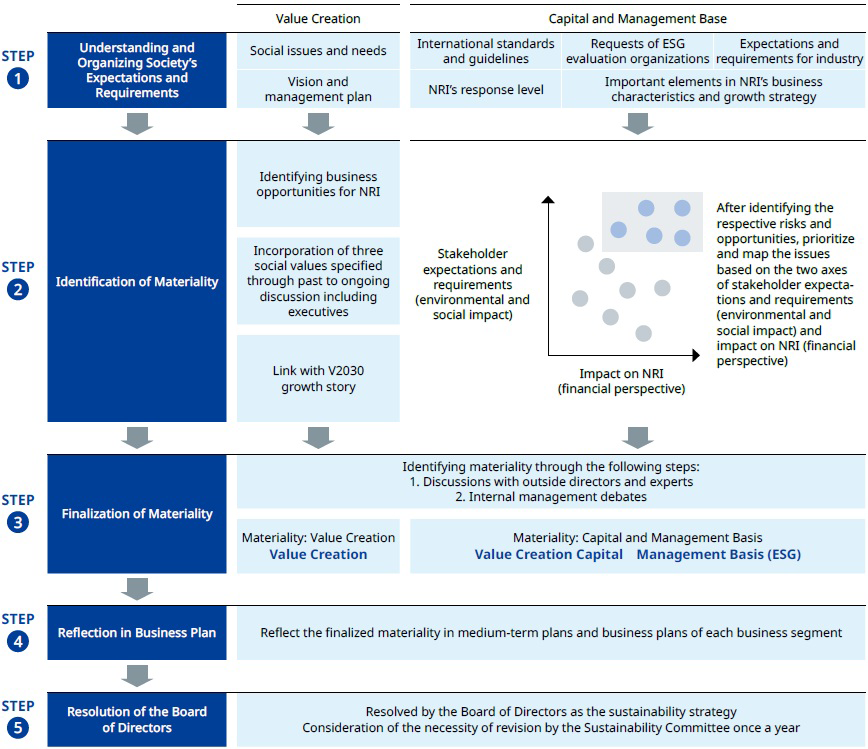
We identify our materiality (key issues) from a management perspective and the perspective of external stakeholders by referring to international standards and guidelines, requirements from ESG evaluation organizations, consistency with our corporate philosophy and growth strategy, and the opinions of outside directors and experts.
In formulating the NRI Group’s long-term management vision toward 2030, NRI Group Vision 2030 (V2030), based on the concept that “building a sustainable future society” and “realizing the NRI Group’s growth strategy” are inseparable, we reidentified our materiality and incorporated it into V2030. This reidentification considered concepts such as double-materiality, taking into account not only the financial impact on us but also stakeholder expectations and requirements (environmental and social impact). Furthermore, we have confirmed that the identified materiality issues are equally important themes toward 2030 even under the concept of single materiality, which focuses solely on impact on NRI (financial perspective).
When identifying our materiality, in light of changes in the social environment and our evolving business landscape, we extracted candidates for themes to focus on toward 2030, and considered the potential short- to long-term risks and opportunities for each candidate. This process also incorporates debates with outside directors and experts, as well as management discussions (STEP 3 in the figure below). The identified materiality issues were approved by the Board of Directors as part of our Sustainability Strategy (Materiality) (STEP 5 in the figure below).
Following this resolution, the Sustainability Committee considers the need to revise our materiality on an annual basis.
1. Identification process of materiality
2. Materiality
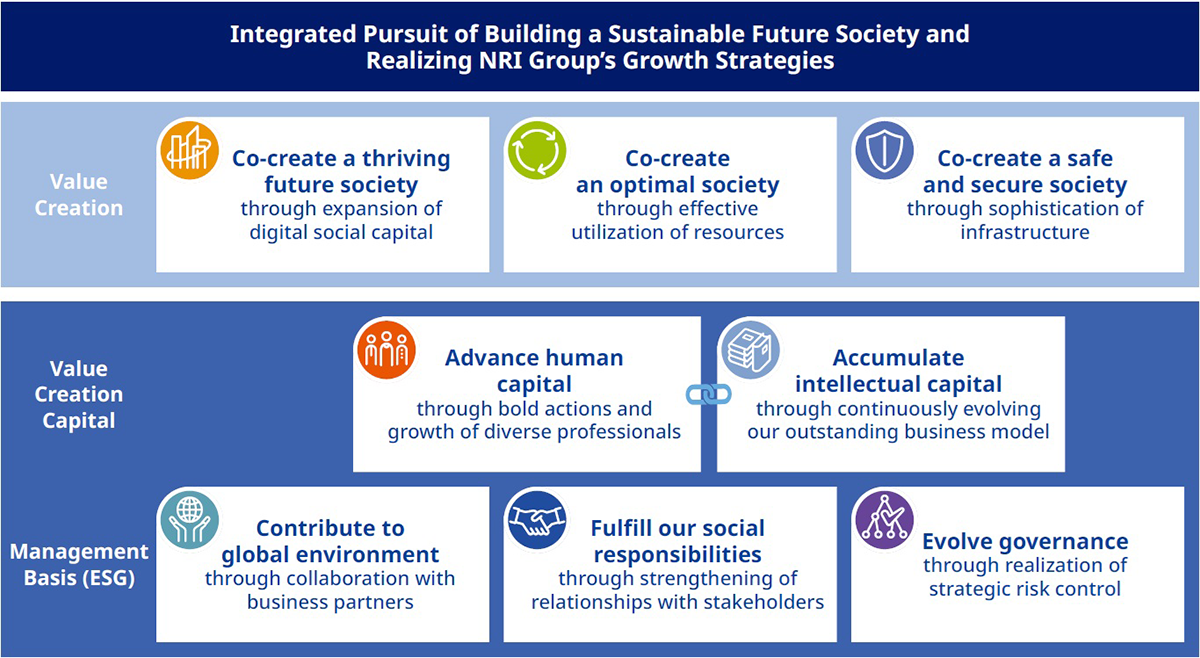
The eight materiality issues made up of three tiers of “value created,” “capital generating value” and “management base (ESG)” are positioned as key elements in the formulation of business strategy and the management decision-making process.
Value Creation
Creating a sustainable future society
※For more information about value co-creation,please click here
| 2030 Goals | Major Initiatives | KPI | FY 2028 Targets | FY 2025 Results | |
|---|---|---|---|---|---|
|
Co-create a thriving future society through expansion of digital social capital |
Derive value from excellent human capital and intellectual capital to expand digital social capital |
|
|
¥80.0 billion (3-year total) |
¥18.1 billion |
|
Co-create an Optimal Society through effective utilization of its resources |
Effectively utilize resources (such as human resources, public assets, IP) and recycle natural resources through the use of business PF and data analytics |
|
|
¥235.0 billion |
¥193.3 billion |
|
through sophistication of infrastructure
Co-create a safe and secure society |
Provide highly advanced IT infrastructure to protect social infrastructure and data from disasters and cyber risks |
|
|
¥128.0 billion |
¥96.2 billion |
- *1AI-related investment is included in intellectual capital investment.
Value Creation Capital
Human and intellectual capital are the source of value creation
| 2030 Goals | Major Initiatives | KPI | FY 2028 Targets | FY 2025 Results | |
|---|---|---|---|---|---|
|
Advance human capital through bold actions and growth of diverse professionals |
Create a workplace where highly skilled professionals with diverse values gather to grow |
|
|
|
|
|
Accumulate intellectual capital through continuously evolving our outstanding business model |
Continuously evolving of the source of our competitiveness (such as business model, brand, and capability) |
|
|
¥195.0 billion (3-year total) |
¥61.7 billion |
- *1AI-related investment is included in intellectual capital investment.
- *2FY 2025 results: NRI (non-consolidated) only; FY 2028 target: Includes domestic Group companies
- *3Covers advanced professionals driving business transformation and productivity innovation through AI
- *4FY 2025 results: NRI Group employees on NRI payroll only; FY 2028 target: Includes domestic Group companies
- *5Total of software investments + R&D and initiative expenses
Management Basis (ESG)
Extending ESG to the supply chain
| 2030 Goals | Major Initiatives | KPI | FY 2028 Targets | FY 2025 Results | |
|---|---|---|---|---|---|
|
Contribute to global environment through collaboration with business partners |
In collaboration with business partners with Scope 3 vision, create a sustainable environment globally and conserve natural capital while promoting more sophisticated use of renewable energies |
|
|
|
|
|
Fulfill our social responsibilities through strengthening of relationships with stakeholders |
Fulfill social responsibilities in the entire supply chain, such as good relationships with stakeholders, creating a healthy workplace, and commitment to human rights |
|
|
100% for major business partners*10 |
98% for major business partners |
|
Evolve governance through realization of strategic risk control |
Strive for balanced governance, including strategic risk-taking, to control risks with long-term perspective |
|
|
0 |
2 |
- *6For Scope3, initiatives are underway toward the FY 2030 target (30% total reduction).
- *7Set in consideration of emissions growth associated with business expansion, etc.
- *8Code of Conduct covering the environment, human rights, and other areas
- *9Percentage of suppliers and contractors (e.g., system development subcontractors) agreeing to the Code of Conduct or maintaining an equivalent code
- *10Based on procurement and transaction values with the NRI Group, etc.